How a small Polish practice designs housing that passes, while they sketch
A compliance question, answered at the sketch
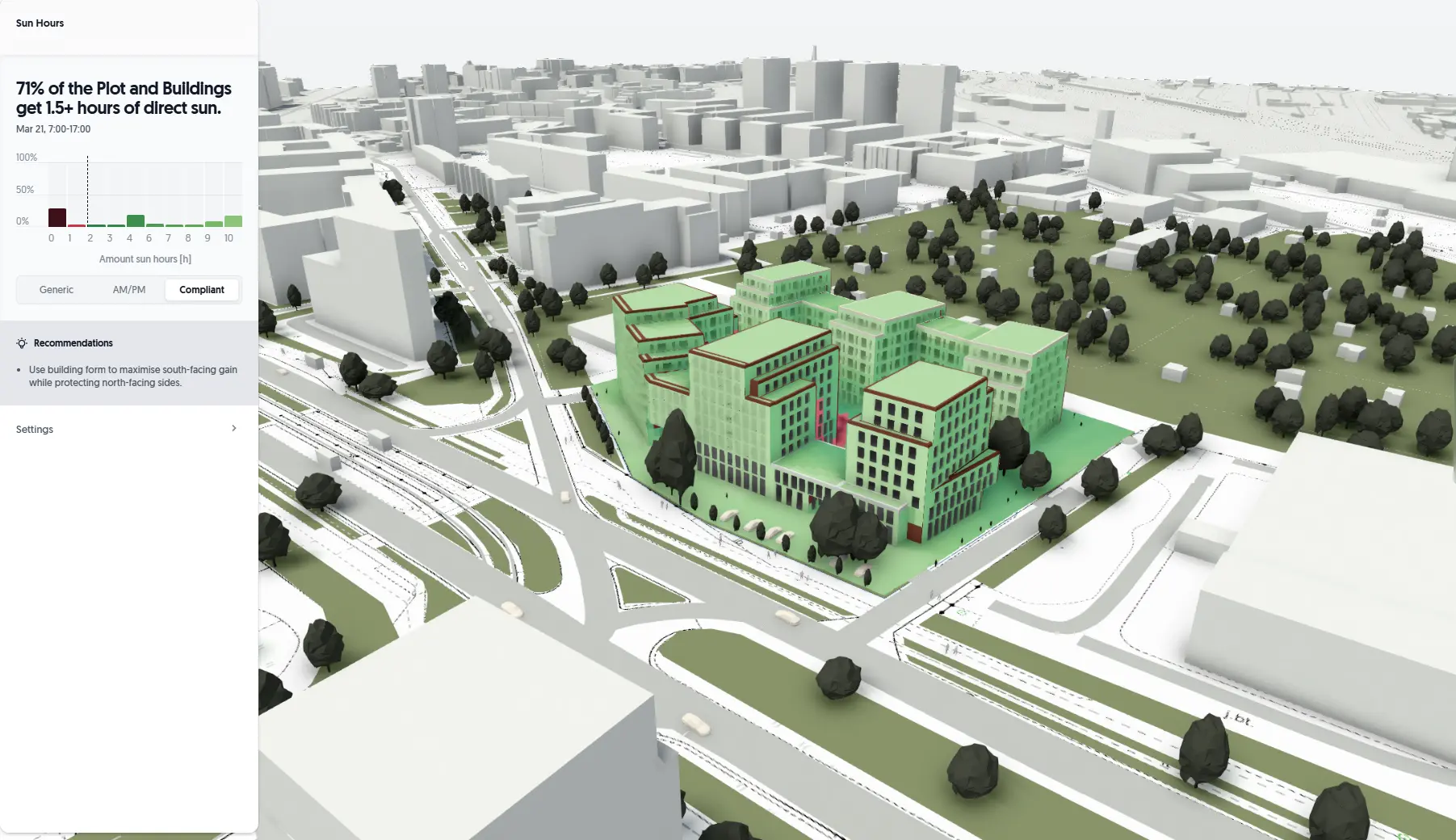
There is a moment in every housing project where the design and the regulation meet, and usually they meet too late. The massing is fixed, the units are laid out, and only then does someone run the numbers and discover that one of the living rooms will not see enough sun. In Poland that is not a soft preference. The building code requires at least three hours of sunlight to at least one living room, and a scheme that misses it does not pass.
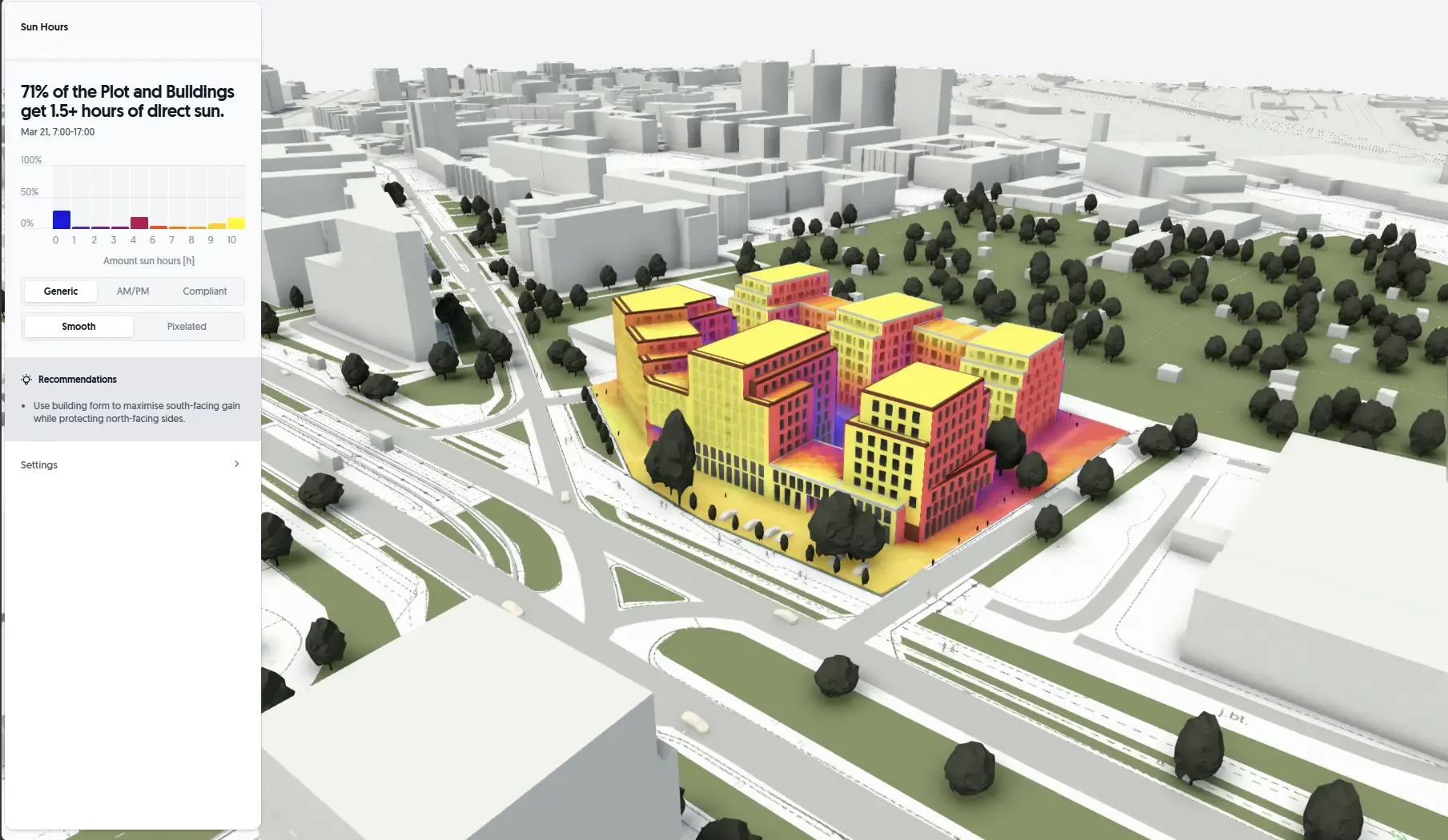
Chill House, a practice in south-east Poland, decided to stop discovering that at the end. For over a year now, the architect Mikołaj and his team have been running their housing concepts through Spacio from the first sketch, and the three-hour rule is one of the first things they check, not the last. "We have to apply at least three hours of sunlight for at least one room for living," Mikołaj puts it. "We check where we have compliance and where we have a problem, and plan our housing correctly."
That sentence is the whole story in miniature. The interesting part is not that they check compliance. Every practice checks compliance. The interesting part is when.

Why the timing is the design problem
Sun access, daylight, and the spacing between buildings are the decisions that make or break a housing scheme. They are also, in most workflows, the decisions you validate last. The reason is structural. To test sun hours properly you have traditionally needed a finished enough model to hand to a consultant or to push through a separate simulation tool, and by the time you have that model, the geometry is already committed. The feedback arrives after the decision it was meant to inform.
This is why so much early-stage work is, in effect, designing blind. You make the massing call on instinct and experience, which for a good architect gets you surprisingly far, and then you wait to find out whether the instinct held. When it does not, the fix is rework, and rework at that stage is expensive because everything downstream has already moved.
For housing specifically, the cost is not only the practice's time. A living room that misses its three hours is a room someone will actually live in. The gap between a flat that gets morning light and one that does not is the gap between a home people settle into and one they tolerate until they can move. In Poland the code floor is a hard line, and crossing it late is the difference between a scheme that proceeds and one that goes back to the drawing board.
The workflow Chill House moved forward
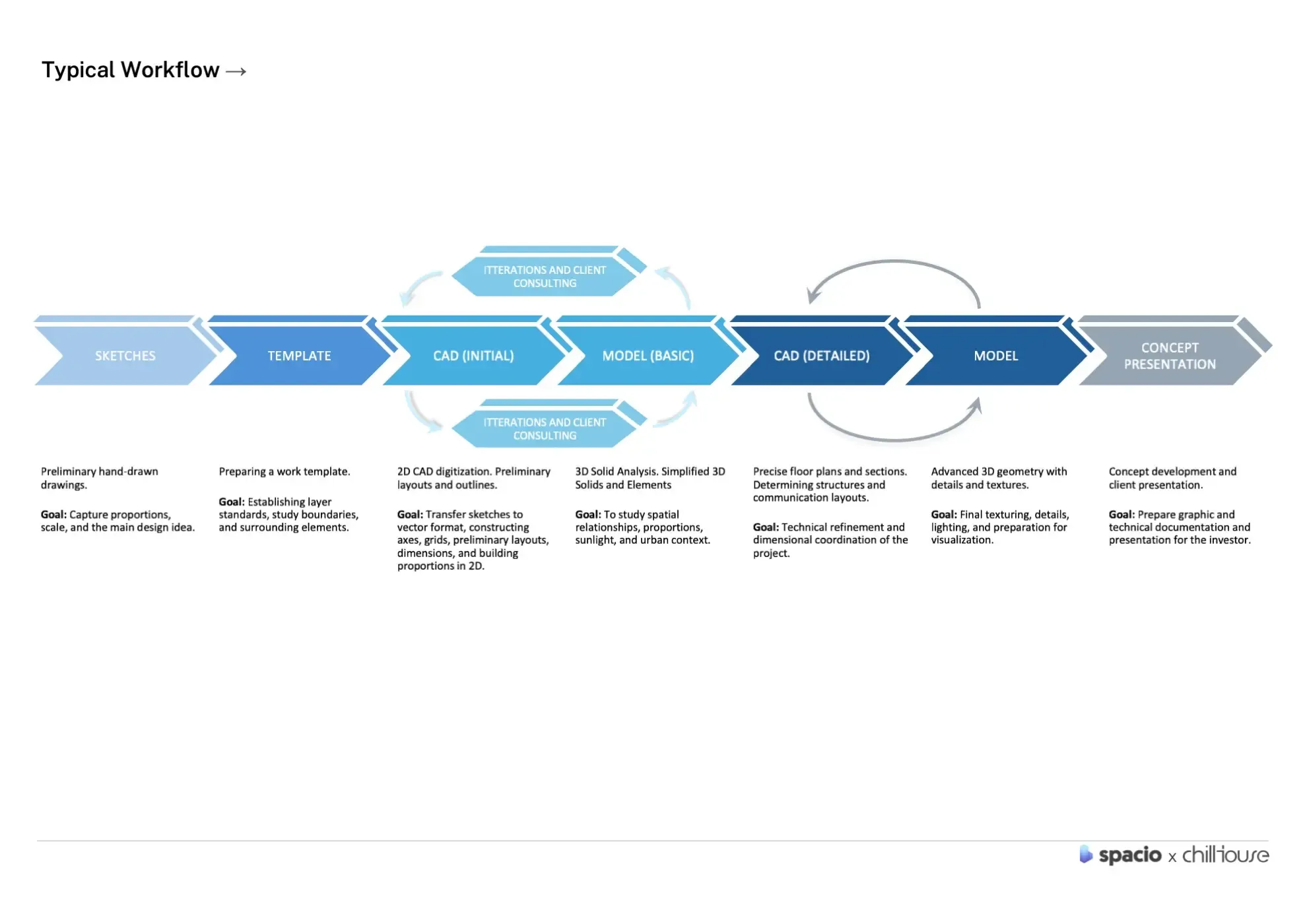
Chill House documented their own process in a deck they titled "Shifting workflow forward," and the title is the argument. They drew out their typical housing workflow as seven stages: sketches, a template, an initial CAD drawing, a basic 3D model, detailed CAD, a refined model, and finally the concept presentation, with iterations and client consulting running across the whole chain. The goal of that early model, in their own words, was "to study spatial relationships, proportions, sunlight, and urban context." Sensible. The problem is that it sat in the middle of the chain. You only got to study sunlight once you had built the model to study it with.
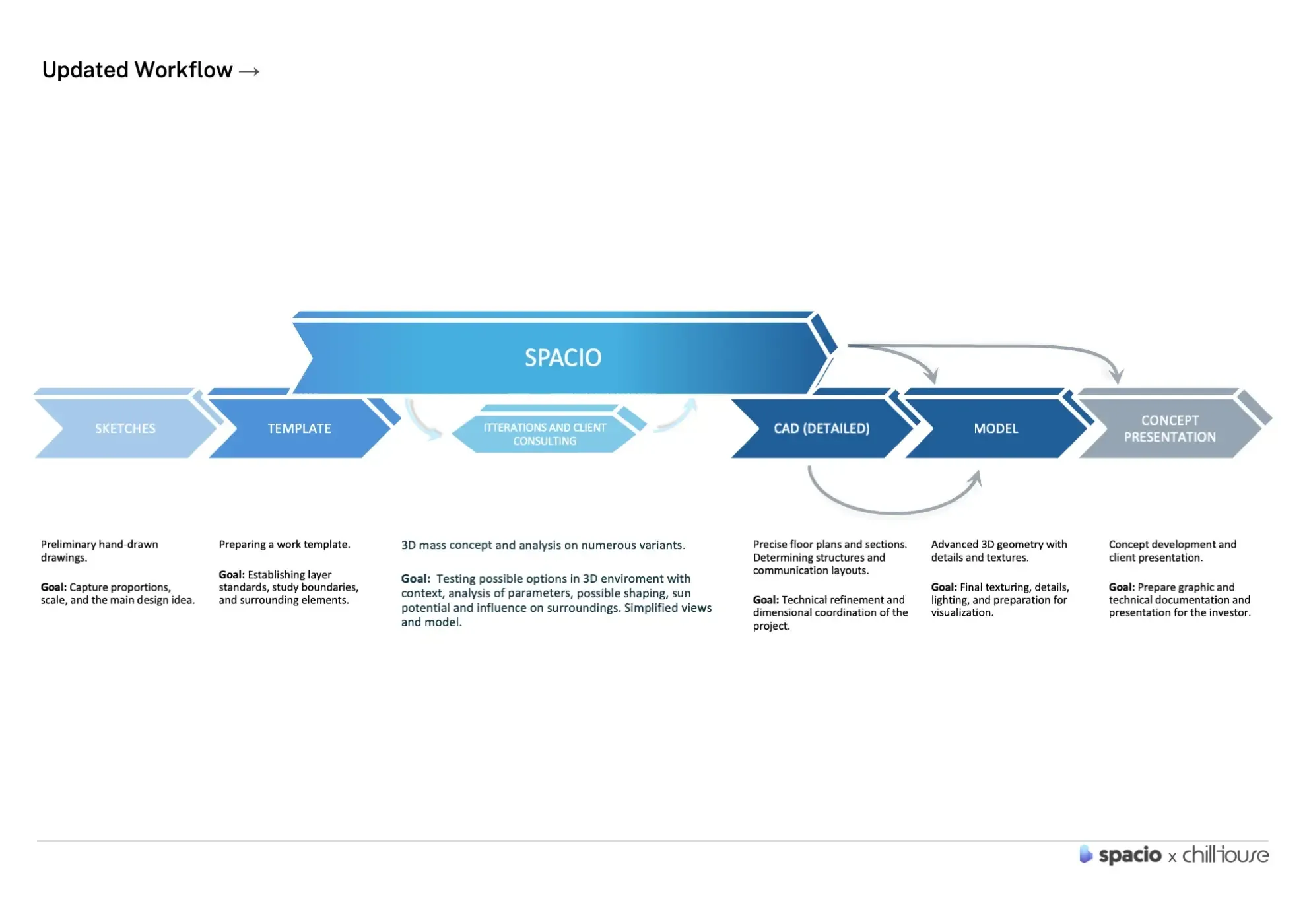
In the updated workflow, Spacio collapses the initial CAD and basic model steps into a single fast massing step. Instead of drawing, then modelling, then analysing, the practice imports the plot outline, sketches the massing directly in realistic site context, and reads the metrics as the form takes shape. Their own description of that step is "testing possible options in 3D with context, parameters, shaping, sun potential and influence on surroundings." The analysis is not a stage that comes after the massing. It is the surface the massing is drawn on.
That is the shift the whole deck is built around: moving the analysis and the decisions it drives earlier, into the sketch, rather than after the CAD model is locked. It is a small change to a diagram and a large change to how a project actually unfolds.
Iterating plot variants with the metrics live
The clearest sign that this has become a genuine working method rather than a one-off experiment is the volume. Chill House have run more than twenty concepts through Spacio since they started, and on a single project they will test plot variant after plot variant, watching the metrics update as they go.
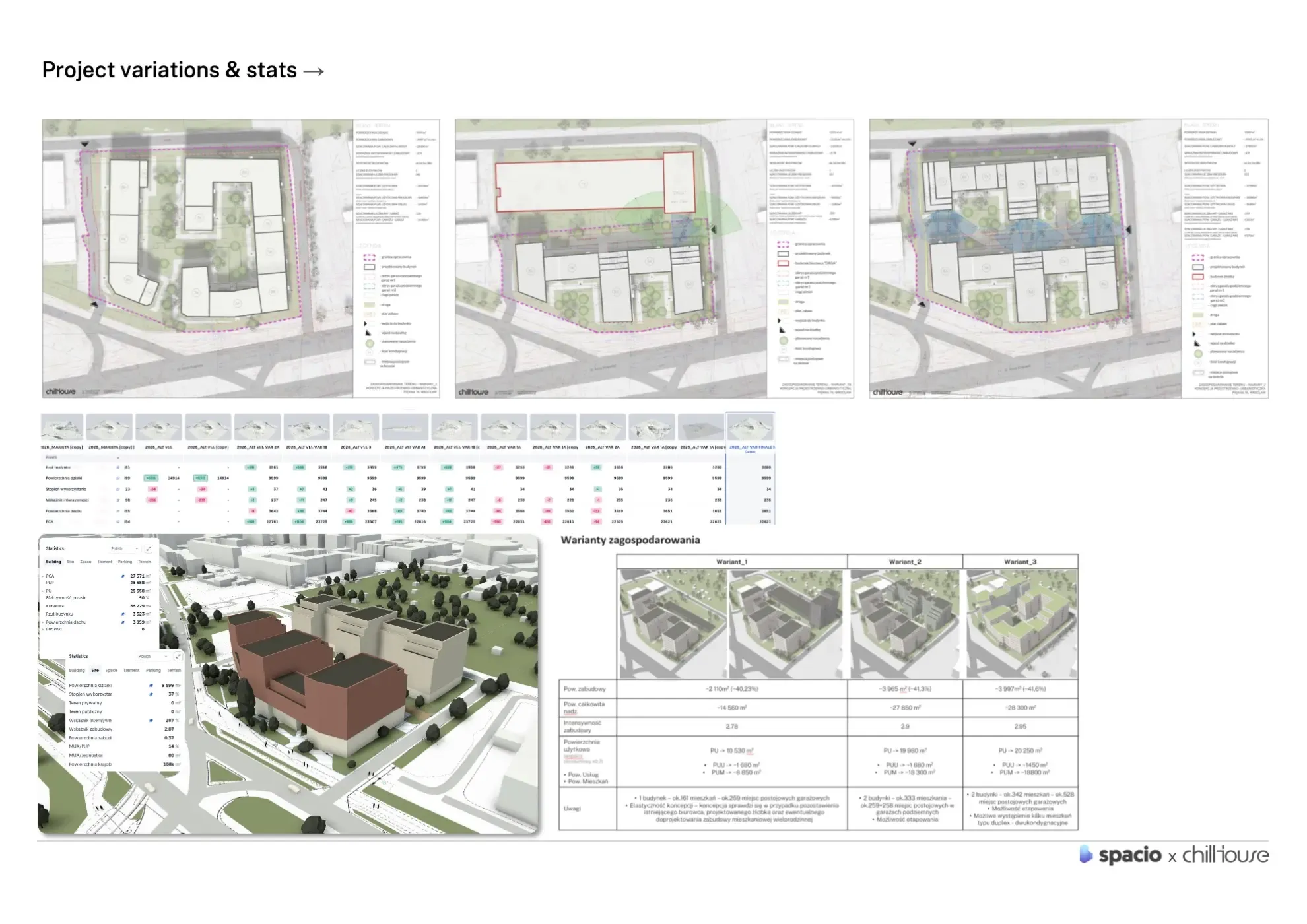
This is where the live feedback loop earns its place. The team imports a plot outline, sketches a massing option, and the sun hours, daylight potential, and area read out against that geometry immediately. Move a volume two metres, step back an upper storey, rotate the block, and the numbers move with the form. No export, no tool switch, no waiting for a report that will be stale by the time it lands. The practice describes having tested close to every layout a plot would take, which is only possible when the cost of one more option is seconds rather than days.
The compliance check rides along with this. Because the three-hour sunlight rule is evaluated live against whichever variant is on screen, "where we have compliance and where we have a problem" is visible in the same view as the massing decision that causes it. The architect is not validating a finished scheme against the code. They are steering the scheme through the code as they draw, treating the regulation as one more force shaping the form rather than a gate at the end.
There is a quietly practical detail here too. Chill House copy the live statistics straight onto the boards they send clients. The same numbers that guided the massing decision become the numbers that justify it to the client, with no separate reporting step in between. The analysis that shaped the design and the analysis that explains the design are the same analysis.
What the wind tool found in the courtyards
Sun is the headline, but it was not the only thing the early analysis caught. Housing schemes in this part of Poland lean on courtyards, and courtyards have a microclimate of their own. When Chill House looked at wind comfort across their layouts, the tool surfaced something they had not expected.
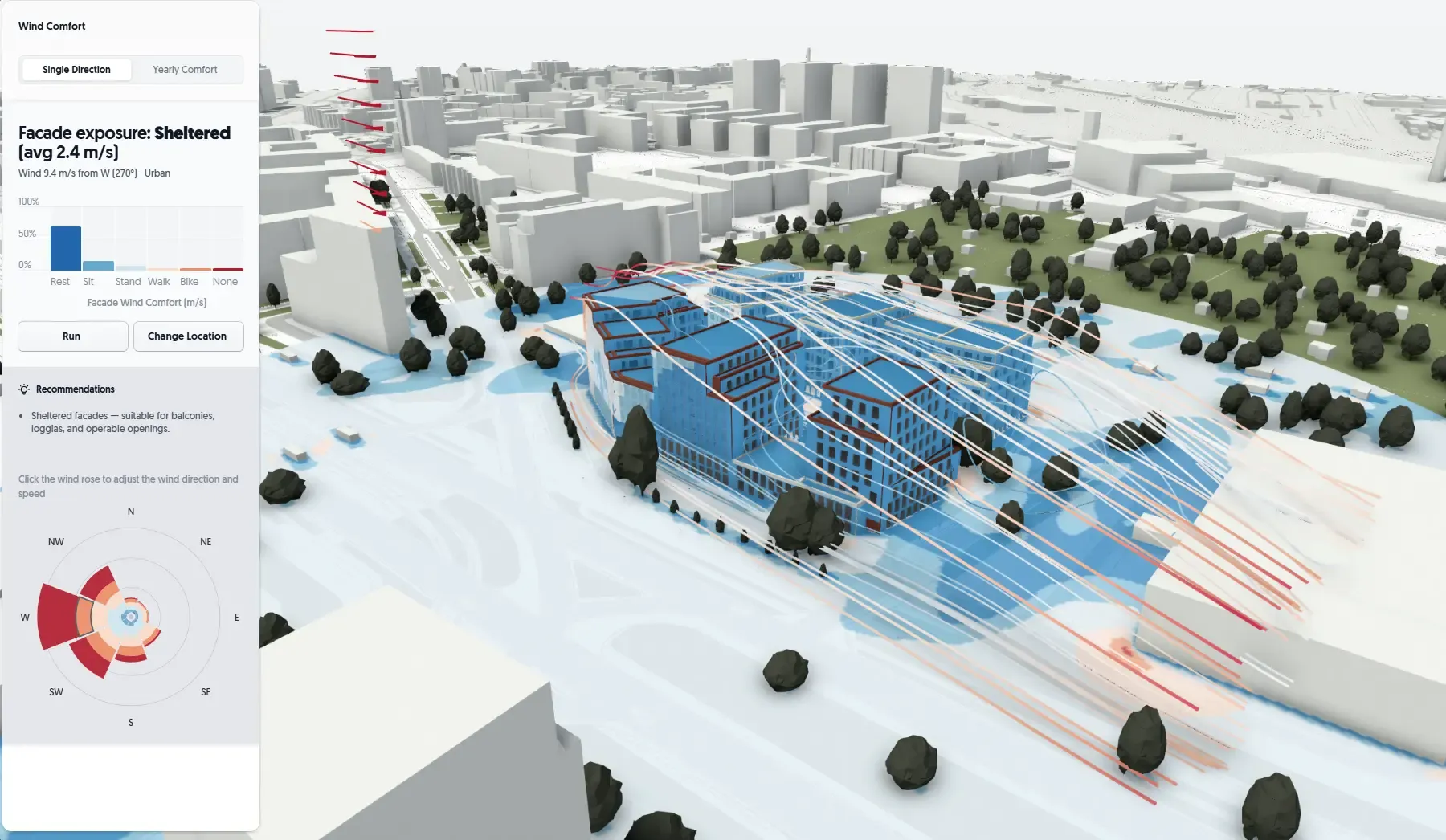
"Thanks to the winds tool we were able to see some very weird vortexes creating in our courtyards," Mikołaj says, describing them as "little local tornadoes." Enclosed courtyards recirculate wind in ways that are hard to predict by eye; a layout that looks sheltered on the plan can spin up uncomfortable gusts at the exact spots where people are meant to sit. Having seen the vortexes while the layout was still soft, the team designed them out with a few simple changes to the arrangement of volumes, rather than discovering them after the courtyard was built.
This is the same principle as the sunlight check, applied to a different metric. The value is not that the software knows about wind; it is that the architect finds out at the one moment when the layout can still cheaply change. Microclimate, like compliance, is far easier to fix as a sketch than as a finished courtyard.
Why this matters now
The timing of all this is not incidental. From 29 May 2026, the EU Solar Standard under Article 10 of the recast Energy Performance of Buildings Directive (EU/2024/1275) applies to permit applications, pushing solar readiness up the agenda across the bloc. In Sweden, Boverket's revised building regulations, the new BBR and EKS, reach their hard cutover on 1 July 2026. The regulatory floor across Europe is rising, and it is rising fastest at exactly the early stage where massing and orientation are decided.
A point worth being precise about: what Chill House check live is sun hours, daylight, wind comfort, and site context. The solar framing here is about massing and shading, how the form catches and blocks the sun, and not about predicting photovoltaic output. That is a deliberate boundary. The discipline of the method is knowing which questions the early analysis answers well and which it does not.
But the questions it does answer, sun access, daylight, courtyard comfort, and code compliance, are precisely the ones the new regulations turn on, and precisely the ones that have always been most expensive to get wrong late. A practice in Poland has spent a year showing that you do not have to wait for them.
What changes when the feedback comes early
None of this replaces the architect's judgement. Chill House still make every design decision; the live metrics do not draw the building for them. What changes is the order of events. Instead of designing a scheme and then finding out whether it passes, they design through the constraints with the consequences visible from the first sketch, which means the twentieth concept gets the same rigour as the first, and the client board carries the real numbers because the real numbers were there all along.
The lesson generalises past one practice and one country. Wherever the code sets a hard line, on sunlight, on daylight, on outdoor comfort, the cheapest place to meet it is the sketch, and the most expensive place is the permit desk. The tools to bring that feedback forward exist now. The practices that move their analysis earlier are not working harder; they are simply finding out sooner.
If you want to test a massing option against sun hours, daylight, and site context while you sketch it, you can try it for free at app.spacio.ai.
Albert Mansard